


No-code AI agent builders lower the barrier to entry considerably by enabling non-technical users to build, deploy, and monitor AI agents. Agentic AI systems, which are highly complex AI entities, can now be built and managed through no-code platforms, allowing users without extensive programming skills to create and deploy AI agents for a wide range of workflows across industries.
However, not all no-code (or low-code) AI agent builders are alike, and many don’t fit the use cases of the average enterprise. Differences in integration, scalability, security, and customization determine whether they can support complex IT, HR, and finance workflows.
In this article, we’ll walk through some of the top options and their suitability for use in enterprise operations, serving as a guide to finding the best no-code AI agent builders by highlighting features, ease of use, and integrations.
What is a no-code AI agent builder?
A no-code AI agent builder allows non-technical users to easily create and deploy AI agents. Most platforms offer a drag-and-drop builder, visual builder, and visual interfaces to make the process intuitive and accessible for both technical and non-technical users.
These platforms often allow users to provide natural language instructions to define agent behavior, making it easy to communicate requirements and automate workflows. The best agent builders also provide reusable templates, logic blocks, API integrations, and conditional logic. No-code AI agent builders also typically use drag-and-drop interfaces and visual workflows to simplify the creation process.
Key features include:
- A visual, drag-and-drop builder
- Workflow visualization
- Reusable templates
- Logic blocks
- API integrations
- Conditional logic
How do low-code AI agent builders compare to no-code builders?
The key difference between no-code and low-code AI agent builders is the level of coding knowledge required to operate them: no-code platforms only use a visual or conversational interface, while low-code platforms combine these interfaces with minimal custom code (like JavaScript snippets) to increase flexibility. Low-code platforms also enable the creation of custom agents by allowing users to combine visual interfaces with custom code, such as Python, for tailored and flexible AI solutions.
| Feature | No-Code | Low-Code |
| Coding Requirement | None | Minimal code, primarily using a visual or conversational interface |
| User Skill | Non-technical users | Users with basic coding knowledge |
| Development Speed | Fastest for simple workflows | Faster than full code, but slower than no-code (for the basics) |
| Customization | Low (only through pre-built integrations) | Moderate |
| Debugging | Reliance on platform support | Direct code access for fixes |
The best no-code AI agent builders combine ease of use, powerful integrations, and enterprise-grade security.
Top no-code AI agent builders at-a-glance
In 2025, 78% of organizations used AI in some capacity, up from 55% the previous year. This surge in demand has triggered an explosion in AI systems and tools, and no-code AI agent builders are no exception. Many platforms now offer custom pricing and flexible plans, with paid plans starting at specific price points, which are important considerations for enterprise buyers seeking scalable solutions with advanced integrations and security features.
Here’s a summary of the top platforms and their suitability for various use cases. Below is our evaluation of how well each tool works for enterprise use cases, especially in IT, HR, and finance.
| Platform | Best For | Ease of Use |
| Aisera | Enterprises; Domain-specific agents for IT, HR, & finance | Easy |
| Lindy | Sales, ops, and support teams | Very easy |
| Relevance AI | Multi-agent workflows, enterprise | Moderate |
| Postman Builder | Developer teams; API-based workflows | Difficult |
| Budibase | Internal app building | Easy |
| Lyzr | Secure AI ops in enterprise | Moderate |
| Zapier | Simple automations | Easy |
| Make | Complex logic and visual workflows | Difficult |
| Retool | Development-heavy internal tools | Difficult |
| n8n | Workflow automation with strong integrations for building AI agents | Moderate |
Aisera
Aisera’s AI agent platform features Agent Composer, which provides a no-code/low-code canvas for creating autonomous agents using natural language. Users can also choose from an extensive library of out-of-the-box, purpose-built AI agents that orchestrate complex actions.
AI agents created with Aisera can be saved to the agent library for future use across IT, HR, and other use cases. Built on the TRAPS framework, Aisera delivers trusted, private, and secure compliant AI agents that meet strict compliance requirements and automate tasks across the enterprise.
Aisera’s AI compliance features are comparable to those of Watsonx.ai by IBM, which also offers a comprehensive suite of tools for building agentic systems with a strong focus on enterprise security and compliance.
Lindy
Lindy is a popular no-code AI agent builder, especially for small businesses and consumers. This platform is tailored for non-technical teams to automate business workflows like sales, support, and operations through a drag-and-drop interface. Lindy also boasts 4,000+ integrations, as well as multi-agent system, and SOC 2/HIPAA compliance. While the platform features easy setup, users find it difficult to create and test more complex workflows.
Relevance AI
Relevance AI includes a no-code/low-code AI agent builder that enables users to add skills through an accessible, visually-based workflow tool. The platform also includes natural language interaction to enable iterative improvement, plus the ability to orchestrate multiple ai agents to collaborate on complex tasks. However, Relevance has a steeper learning curve than other agent builders, and basic coding knowledge is needed to get started.
Postman Builder
Postman also offers an AI agent builder within its broader API ecosystem. The platform’s visual workflow helps developers create and deploy AI agents for API tasks, supporting multiple AI models and including enterprise-grade security capabilities. Key features include AI request blocks in flows, seamless workflow integration, and compliance for large organizations. However, it is built first and foremost for developers and, as such, requires extensive coding knowledge to operate.
Budibase
Budibase is an open-source, low-code platform that is mainly used for building internal tools and dashboards. However, the platform does incorporate AI for automation, data modeling, forms, and lightweight workflows via drag-and-drop UI blocks and custom JavaScript. It also connects to SQL databases, REST APIs, spreadsheets, and LLMs. It works well for organizations just getting started with AI, but lacks the full agentic focus that most enterprises need.
Lyzr
Lyzr is a low-code agent framework for GenAI apps. It features pre-built agentic RAG pipelines, SDKs, and agents for chat, search, and even industry-specific tasks. It does require some coding knowledge to operate, making it particularly useful for developers who want to launch agents quickly without customizing each line of code.
Zapier
Zapier enables users to build agents using natural language, then integrate those agents with various data sources and a library of 8,000+ app integrations. The platform supports quick builds for modular workflows across popular applications.
Make
Make (formerly Integromat) functions as a low-code automation platform with visual builders for complex AI agent workflows. The platform’s visual interface supports intricate branching, API connections, and multi-step logic. However, many users report that the platform has a steep learning curve, which can slow down time to value.
Retool
Retool’s low-code environment allows users to build internal AI-powered apps and agents with drag-and-drop components, database queries, custom JavaScript, and LLM integrations for dashboards and workflows. The platform is difficult for most users to start with, but it can be helpful for experienced developers to accelerate their current building and testing processes.
n8n
n8n is an open-source, low-code workflow automation tool with a node-based visual editor for AI agents. It supports custom logic, API and tool integrations, and multi-agent setups, handling complex backend plumbing for LLMs, custom functions, and scalable enterprise flows without heavy infrastructure management.
Key benefits of low-code/no-code AI agent builders
Low-code/no-code AI agent builders have changed the game in terms of overall capability and accelerating AI adoption. For enterprises, they can turn complex processes into autonomous workflows that orchestrate systems and interact with end users with minimal human input. No-code tools can also democratize AI development, allowing more employees to contribute to automation efforts. Additionally, good AI agent builders typically feature streamlined dashboards and other performance tracking features, allowing for easy monitoring and optimization of agent performance.
Accessibility for non-technical users
AI agent creation is now no longer limited to just developers. Non-technical users can now build and deploy AI agents using a simple interface like Aisera’s natural language agent builder, which allows the use of natural language inputs to create agents without coding. Users define the agent’s behavior, personality, and role in plain English within a configuration screen instead of manually writing code.
By increasing accessibility, this facilitates stronger collaboration between domain experts and developers, as well as opens the door for more tailored workflows in niche and highly regulated sectors.
Faster deployment
Because low-code/no-code AI agent builders accelerate so much of the AI agent development process, they significantly reduce deployment times. Rather than traditional manual coding, which can take months of setup, code creation, and review, AI agent builders can accelerate the development process and enable organizations to achieve faster time to value.
Simplified testing and iteration
Because users can make changes to AI agents through easy-to-use visual and natural language interfaces, they’re able to test agents and make quick updates as market expectations change.
Users can also monitor and customize agent behavior, allowing for performance improvements through debugging and workflow customization. This enhances scalability without the need for a complete overhaul when conditions change.
Critical enterprise features for no-code AI agent builders
Integrations and connectors
Enterprises often have a number of legacy platforms with data and functionality that AI agents need to access. It’s important to find a platform that provides pre-built connectors to APIs, databases, CRMs, other enterprise applications like Salesforce or Snowflake or the ability to add custom endpoints. This allows your AI agents to access data and make changes in real time.
Scalability
Whether your enterprise handles thousands of queries daily or needs to account for seasonal peaks, it’s important to choose your agents accordingly. Choose a cloud native application that can support auto-scaling, load-balancing, and serverless execution to handle high-volume tasks.
Cost efficiency
One of the core advantages of AI agents is their cost efficiency, but it’s critical to choose a platform that provides the features you need at a manageable cost. Some AI agent builders operate on a token usage-based model, which can increase costs quickly. Additionally, look for AI agent builders that have pre-built AI agent libraries or reusable templates to reduce total ownership costs.
Developer support
Although no-code agent builders are especially beneficial for non-technical users, the complexity of modern enterprises means that at some point, you will likely still need developer support for custom or advanced use cases. Look for AI agent builders with these features to assist developers:
- Robust documentation, community templates, and API triggers
- An active community of users and developers for support, innovation, and extensibility
- Analytics dashboards to track performance and make ongoing refinements
- Version control, collaborative workspaces, and debugging visualization
Domain-specific models, memory, and context
The more knowledge your AI agents have about your specific domain, the better. AI agents with domain-specific knowledge deliver more accurate answers that capture the unique nuances and complexities of specific domains. Make sure your low-code/no-code AI agent builder includes domain-specific LLMs, persistent memory stores, and adequate context windows for high-quality AI agent interactions.
Real world use cases for no-code AI agents
No-code AI agents in IT
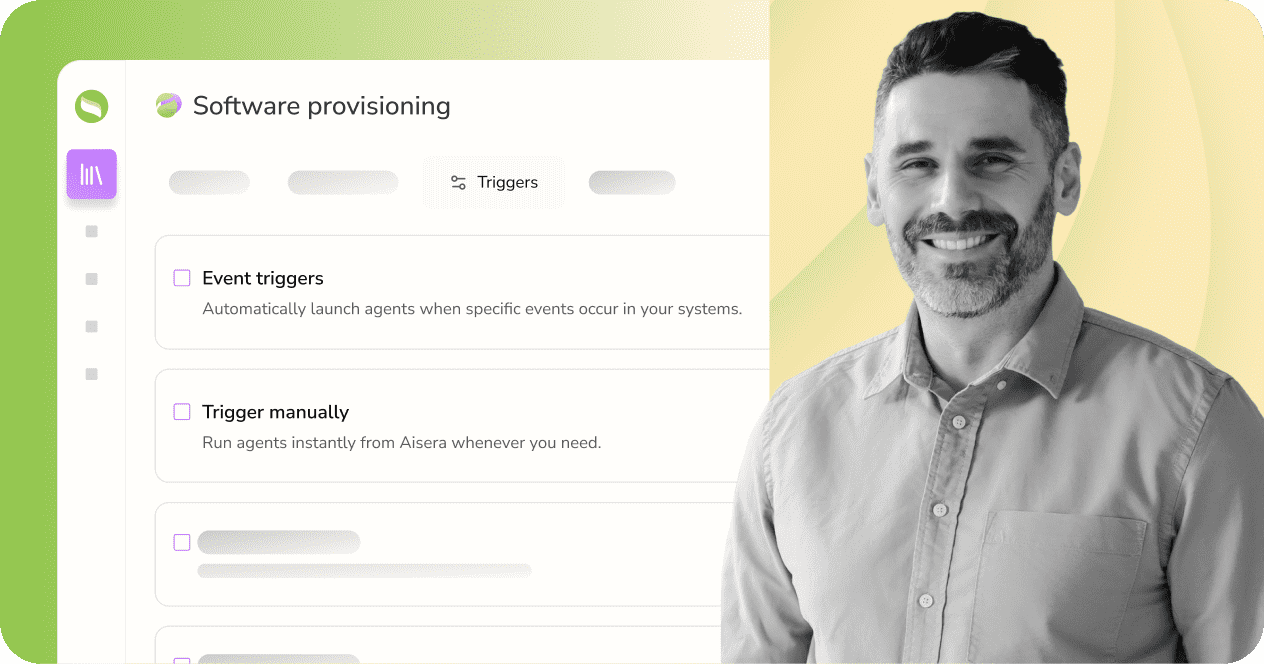
IT teams can reduce ticket volumes and free up time for their staff by leveraging AI in information technology. With AI agents that can automate repetitive support tasks, such as:
- Resolving routine requests like software provisioning, access provisioning, password resets, technical troubleshooting, and more automatically for IT support agents
- Automating server monitoring, anomaly detection, workload scaling, and update deployment to reduce the occurrences of system downtime and outages
- Customizing workflow orchestration to automate multi-system tasks such as incident routing and asset lifecycle management
No-code AI agents in HR
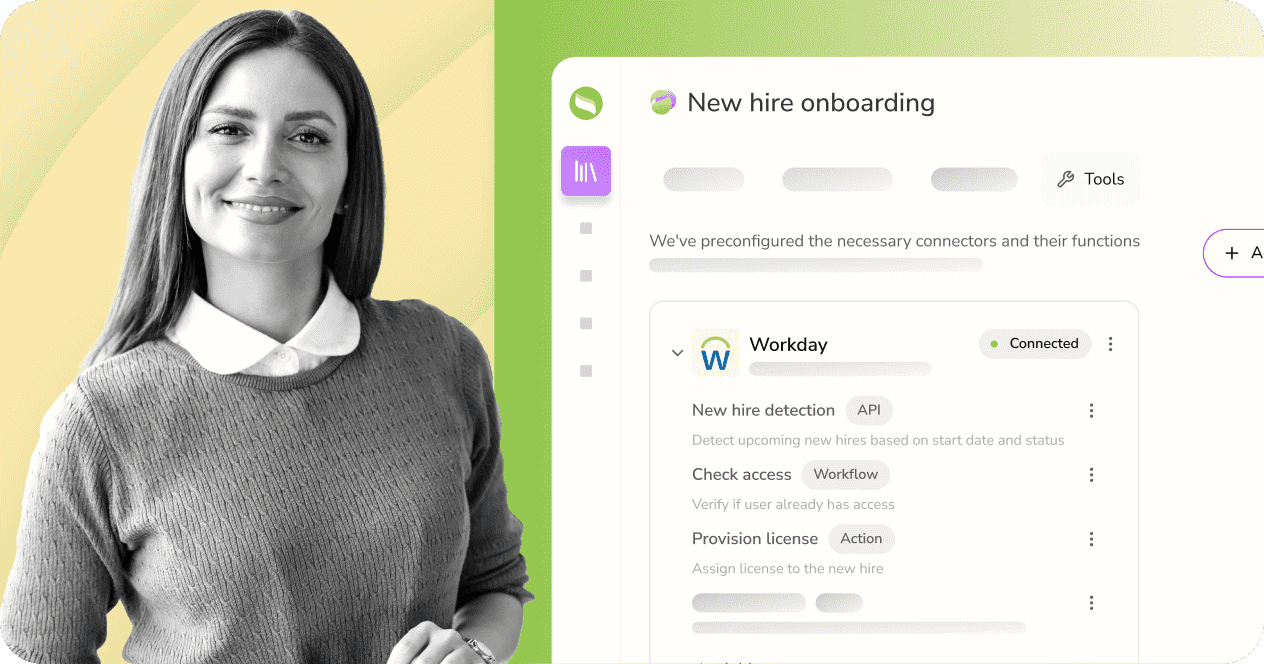
Agentic AI in HR focuses on supporting their teams while also reducing compliance risks and improving the overall employee experience. Here are a few examples:
- Automating common employee tasks such as onboarding, benefits management, badge and access requests, and more
- Delivering accurate answers instantly for questions about company policies, upcoming benefits, and more
- Streamlining tasks for HR managers, such as creating candidate summaries for recruitment, analyzing workforce data, or sending reminders for upcoming trainings
No-code AI agents in Finance
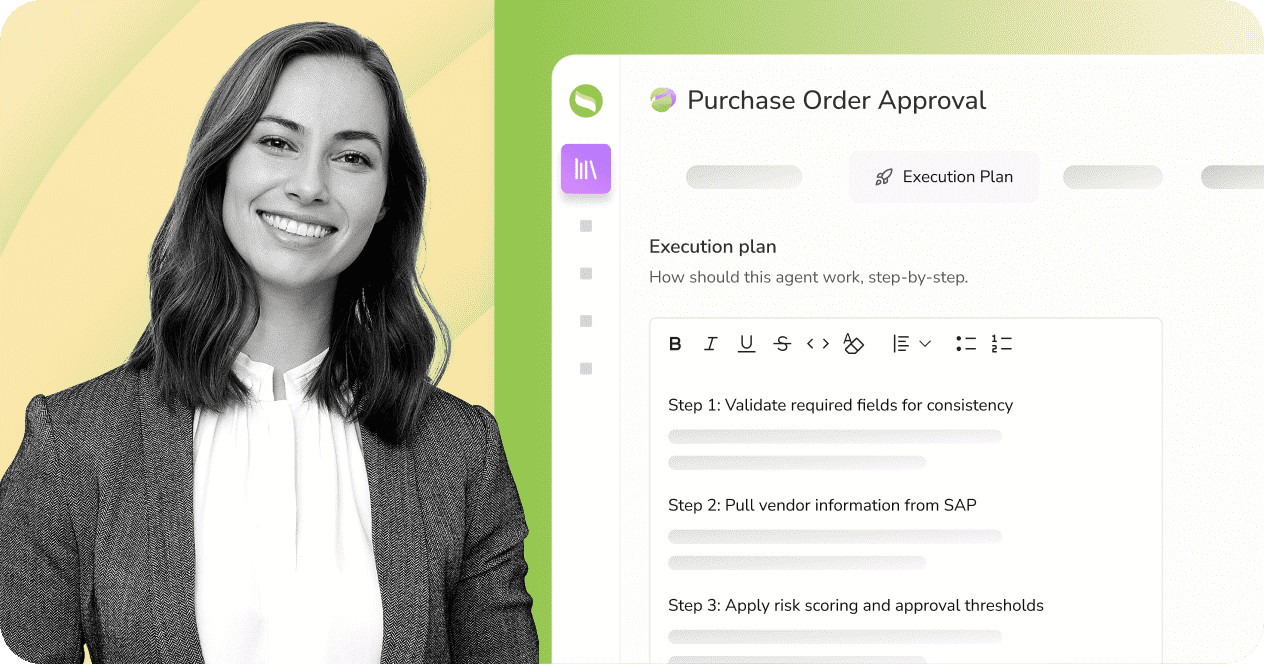
Time is money for finance teams, and AI in fintech can help them save both by automating critical workflows and facilitating faster, data-driven decision-making. Here are a few tasks they can streamline:
- Accelerating document processing with automated data extraction from invoices/contracts and validation against POs.
- Delivering continuous compliance monitoring that can flag deviations from policies and trigger alerts and corrections across systems
- Supporting faster, more comprehensive decision-making with real-time data analysis and tailored recommendations
Final thoughts on no-code AI agent builders
No-code AI agent builders speed up deployment and democratize agent creation, enabling non-developers to build an AI agent without needing to write a single line of code. However, this ease of use often comes with tradeoffs – some AI agent builders lack the customizability, integration capabilities, and enterprise-grade features that are needed to tackle real, complex use cases. For organizations with legacy systems or advanced workflow needs, these limitations can make simpler platforms a non-starter.
Aisera is built to bridge the gap, combining an easy-to-use AI agent platform with enterprise-grade features that provide the security and scalability enterprises need to grow. Aisera’s AI agent platform features:
- A low-code/no-code Agent Composer that allows users to create AI agents using natural language, as well as a robust AI agent library and built-in support for 100+ integrations
- Domain-specific agents that use contextual intelligence to deliver fast, accurate resolutions
- Task Agents to execute approvals/procurement via ServiceNow/Workday/Teams integrations
- Native support of standards such as Model Context Protocol (MCP) and Agent-to-Agent (A2A) with Aisera Unify
- Enterprise security with AES-256 encryption, RBAC, audit logs, and full interoperability across ITSM/CRM tools
- Seamless deployment options across major cloud providers (AWS, Azure, GCP), VPCs, hybrid clouds, and on-prem environments
No-code platforms also allow businesses to update AI agents quickly to reflect policy changes, keeping operations aligned with governance.
See how Aisera makes it easy to build AI agents that transform your enterprise. Schedule an Aisera demo here.