

Introduction to Enterprise Knowledge Management
There was a time when enterprise knowledge management (EKM), the process of capturing, organizing, and sharing knowledge resources within organizations, was a “nice to have.” Companies that invested in it anyway routinely performed better, with teams improving their productivity by 39% and bringing in 23% more revenue per employee. But in the era of AI, knowledge management has become table stakes, and EKM is critical to improving collaboration and preventing knowledge silos.
Before we reach that potential future, today’s AI agents and models require sophisticated information retrieval capabilities to function. Whether using retrieval-augmented generation (RAG) to enhance queries, training domain-specific LLMs for industry-based tasks, or giving an agentic AI system access to systems like CRM software to better understand the customers they serve, the accuracy, freshness, and structure of the data are critical components to making faster, more accurate decisions.
In this blog, we’ll explore how businesses can get started with enterprise knowledge management, as well as the AI tools needed to remain competitive as enterprise data continues to expand. Effective EKM provides a competitive advantage and delivers real business value by enabling teams to make informed decisions, optimize access to information, and support long-term success.

What is Enterprise Knowledge Management in Simple Words (EKM)?
Enterprise knowledge management (EKM) is the process of collecting, organizing, sharing, and analyzing the collective knowledge within an organization. It follows the principles of basic knowledge management but extends to the scale and complexity of enterprise search, where information is spread across multiple teams, systems, and geographies.
Organizational knowledge includes both explicit and tacit insights that are critical to the business. Managing this knowledge helps prevent knowledge loss, reduces risks associated with employee turnover, and streamlines work processes by providing access to shared organizational insights.
Key components of enterprise knowledge management include:
- Knowledge capture: Gathering information from various sources, documentation, and employee expertise.
- Knowledge organization: Structuring and categorising that information for future retrieval and use.
- Knowledge sharing: Sharing that information across the enterprise.
- Knowledge transfer: Moving expertise and insights between knowledge workers to ensure continuity and learning.
- Knowledge creation: Generating new knowledge through research, innovation, and collaboration between knowledge workers.
- Knowledge application: Ensuring teams and leaders can use that information to inform decision-making and ongoing operations.
- Knowledge maintenance: Keeping that information relevant, accurate, and up to date.
Core pillars of an EKM strategy
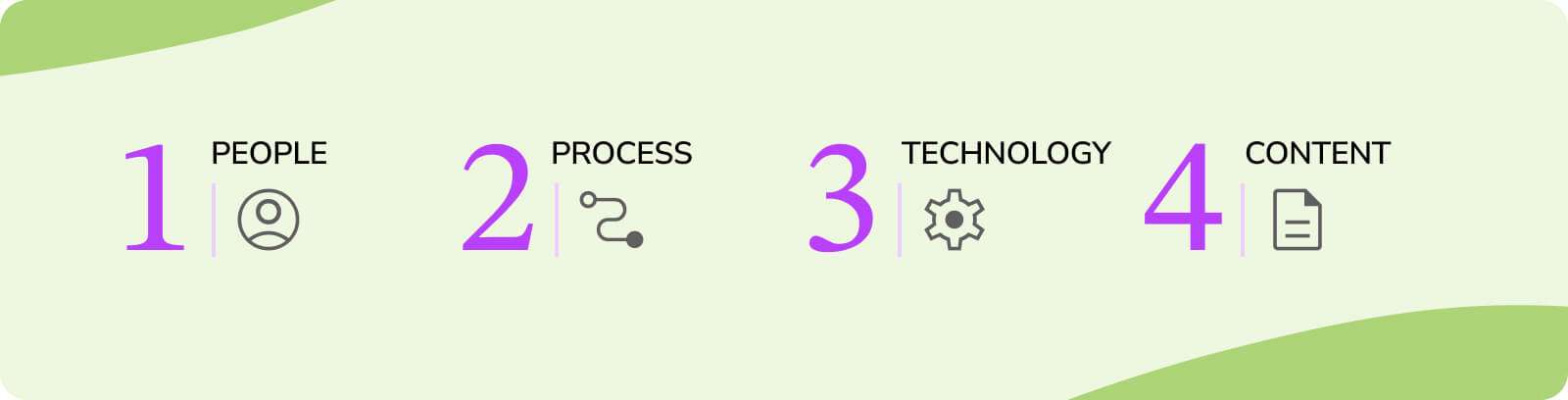
With so much information at an enterprise’s disposal and information being distributed and siloed, EKM can’t be done ad hoc. Leaders must approach it strategically and methodically and build an EKM strategy on these four pillars. Developing an EKM strategy that aligns with overall business objectives is key to integrating with existing processes and driving value across the organization.
1- People
People are the first of these four pillars as they create and consume the knowledge. And the other pillars need to be structured in a way that helps people retrieve, interpret, and deploy that knowledge; otherwise, the rest of these efforts are for nothing. Providing employees with the right resources and support is key to knowledge sharing and to giving them access to the right information quickly. This also enables team members to collaborate and share expertise.
2- Process
Processes in enterprise knowledge management provide guardrails and best practices for people to work within. Knowledge management processes cover all of the above and are key to accuracy, consistency, and efficient use across the enterprise. Integrating knowledge management with existing business processes means knowledge strategies are aligned with operational procedures, and efficiency is improved, resulting in a synchronized approach. These processes are key to managing knowledge through defined processes that support the creation, capture, sharing, and retention of organizational knowledge.
3- Technology
Technology in enterprise knowledge management enables people and processes to scale. For example, knowledge management platforms are essential tools that support the capture, storage, retrieval, and sharing of knowledge across the organization.
Knowledge management software consolidates information from multiple systems and sources into one system, so collaboration is seamless and data is up to date and accurate across departments. Typical examples are knowledge bases, collaboration tools, and document management systems. Next-gen EKM platforms should also use agentic AI to quickly retrieve information, synthesize results, and create a simple, helpful user experience.
4- Content
Content in knowledge management is the actual information that people in the organization need to access. This content should be relevant, accurate, and well-organized, not to mention useful to the team. Documenting explicit knowledge is essential to make it accessible and useful for everyone in the organization. This often includes:
- Standard operating procedures (SOPs)
- Best practices, FAQs, and troubleshooting guides
- Product and service information, including technical details, sales materials, and pricing sheets
- Product knowledge, such as detailed product specifications and troubleshooting guides, to support customer service and sales teams.
- Company policies on HR, IT, security, compliance, and more
- Training materials, such as onboarding guides, e-learning courses, instructional videos, and certification resources
- Customer and case records to surface insights from resolved client issues
- Knowledge articles and wikis
- Templates and forms
- Meeting notes and project documentation
Why is Enterprise Knowledge Management Crucial?
Global enterprise data is expected to pass 181 zettabytes (1 zettabyte = 1 trillion gigabytes) this year, with over 30 billion devices expected to produce that data. This degree of complexity is enormous and is impossible to manage without clear processes and technology. Organizations face major challenges such as increasing complexity as they scale, and the risk of knowledge loss due to employee turnover or poor documentation. As such, EKM has a significant, direct impact on a company’s bottom line.
Streamlined Access to Knowledge
When employees spend hours searching for that single piece of information, that’s time they’re not spending on more critical tasks. Enterprise knowledge management helps avoid both wasted time and redundant work, given that different employees might be searching for the same piece of information. EKM ensures quick access to resources, making information easily accessible and streamlining resource access, so employees spend less time searching for knowledge and more time on high-value activities.
Improved decision-making
By getting more information to leaders faster, knowledge management helps them make more informed, better decisions with fewer gaps and less guesswork. By getting employees access to accurate information, EKM enables decision-making capabilities, so teams can rely on up to date and trusted knowledge for better outcomes.
Agentic AI systems don’t just respond to direct requests. They gather and synthesize information from multiple sources to provide users with valuable insights and recommendations, before the user even asks. This proactive capability gets decision makers to the most relevant knowledge faster and enables them to make smarter, more informed choices.
Less redundancy
In large organizations, it’s common for multiple employees to unknowingly tackle the same problems, leading to inefficient duplication of effort. Enterprise knowledge management solves this by enabling quick capture, storage, and retrieval of solutions across the company. EKM also allows teams to share knowledge efficiently, saving valuable time that would otherwise be spent on repetitive, manual tasks. This not only reduces wasted work but also helps leverage shared expertise and encourages a culture of collaborative problem-solving, empowering teams to build on each other’s insights rather than working in isolation.
Retained institutional knowledge
Enterprises are at risk of losing up to 70% of all institutional knowledge from experienced employees leaving the organization without properly documenting their learned knowledge. Capturing tacit and valuable knowledge is essential to ensure continuity, as it prevents the loss of internal expertise and critical information that might otherwise be lost with employee turnover.
By capturing and making this knowledge accessible, organizations create a lasting legacy that empowers teams to continue growing, innovating, and improving long after those employees have moved on. This continuity boosts resilience and helps the organization build on its collective expertise over time.
How to build an enterprise knowledge management system
Building a knowledge management system is straightforward in theory: set up a centralized repository for knowledge, then load all the information into it. The system should be designed to store information efficiently, ensuring it is easily retrievable for future collaboration and supports organizational knowledge sharing and effective knowledge management strategies.
By the time an organization gets to the size and scale that knowledge management becomes a priority, there are already terabytes of data in various locations, formats, and varying degrees of accuracy that employees need to access. Not only does the information need to be in one location as a “single source of truth”, but it also needs to be set up according to knowledge capture processes so all future information conforms to that system. Here are some best practices for navigating that complex transition.
1. Assess knowledge needs and demands
Before initiating the project, it is essential to clearly define and understand the overall scope to ensure alignment and focus throughout the implementation process. Start by identifying the critical knowledge that your employees need access to and why that information is necessary to meet core business objectives.
Understanding your organization’s knowledge landscape, how information is captured, organized, and shared, helps ensure that knowledge needs are aligned with real business value. To justify the investment in building an enterprise knowledge management system, the initiative must align closely with your organization’s strategic goals, demonstrating clear value and business impact.
2. Prepare the organization
Enterprise knowledge management is a large-scale effort that takes anywhere from months to a year to fully implement. It’s important to prepare your organization for this change and set expectations accordingly. This preparation includes fostering a culture that values collaboration and knowledge sharing, a cultural shift that often requires ongoing commitment. Practical steps to facilitate this transition include:
- Communicating the benefits of knowledge management clearly to all employees to build buy-in and reduce resistance.
- Identifying and empowering knowledge champions or ambassadors across teams who can advocate for and model knowledge-sharing behaviors.
- Providing training and resources that help employees understand how to contribute to and benefit from the knowledge system.
- Implementing regular training to ensure employees are equipped to contribute to and use the knowledge system effectively, and to reinforce best practices.
- Gathering knowledge from team members at the start of projects to build a strong foundation and ensure informed decision-making.
- Updating performance metrics and recognition programs to reward collaboration, information sharing, and contributions to the knowledge base.
- Updating performance metrics and recognition programs to reward collaboration, information sharing, and contributions to the knowledge base.
Laying this groundwork early helps ensure that the enterprise knowledge management initiative becomes part of the organization’s DNA, driving long-term success.
3. Conduct a knowledge audit
For a smooth transition, your organization needs to have a sense of where the enterprise knowledge currently lives and in what format. This alone could take weeks to months to complete, depending on the size of the organization’s current knowledge footprint, both documented and undocumented.
Auditing intellectual capital is crucial to ensure that valuable employee expertise is captured and retained, enhancing organizational value and supporting effective knowledge management. The next step is to document the gaps in that knowledge so the business can build a knowledge management system not just for the present, but for the future.
4. EKM system architecture design
At this point, you’ve laid the groundwork to start designing your enterprise knowledge management system’s architecture. This architecture is essentially a breakdown of all the tools and technologies required to store and retrieve information, as well as the workflows and processes that govern them. The system should be designed to mitigate compliance risks and protect confidential information by incorporating robust security measures and regulatory controls. A well-designed architecture not only ensures seamless access to knowledge but also supports scalability, adaptability, and alignment with organizational goals.
5. Build and pilot the system
After the system is designed, it’s time to implement it. We highly recommend testing with pilot projects, identifying usability issues, then using those insights to refine and expand implementation. At this stage, it’s critical to gather user feedback and iterate.
6. Deploy the system across the enterprise
Now that the pilot has worked, it’s time to roll out the system across the enterprise. There are two sides to this rollout: the technical and the cultural. The technical side is making sure every employee has access to the technology and that all knowledge is stored and organized. And make sure sensitive information is protected during deployment using access controls and encryption to keep confidential business data safe.
The cultural side can be a challenge in itself, building in reward and incentive structures to encourage adoption, a shared learning environment, and even knowledge managers to keep teams aligned to processes.
7. Measure and improve
Once the system is deployed, usage should be monitored to make improvements over time. After all, business conditions change, and knowledge goes stale. To stop outdated information from building up and to ensure up-to-date information is always available, the system should be updated and audited regularly. Ongoing maintenance is key to getting the most out of what is already a big investment.
Key use cases and applications
EKM has as many applications as there are aspects to the organization. Here are three examples that most companies face.
Supercharging customer service & support
EKM provides a centralized, AI-powered knowledge base to help agents, both human and AI, quickly find answers to key customer questions. This enables them to offer personalized, accurate support without sacrificing speed or scale. EKM does this by improving the tagging, taxonomy, and governance of content, making retrieval faster and easier. As a result, EKM can accelerate first-contact resolution, ensure consistency across all channels, and even support robust self-service operations. By enabling faster, more accurate support, EKM directly enhances customer satisfaction.
Streamlining IT & helpdesk operations
The knowledge management systems can link structured knowledge repositories with AI service desk software, such as automated ticketing systems, IT service management (ITSM) platforms, and help desk tools, enabling agents to deliver consistent, speedy resolutions to support inquiries.
IT agents can also embed critical information like troubleshooting steps, FAQs, and resolution protocols directly into their responses, enabling users to resolve issues faster and reducing the need for further manual intervention. What’s more, knowledge management systems can automatically build more robust documentation by capturing solutions and insights, which saves time for IT agents and enhances self-service capabilities for users in the future.
Empowering HR & employee onboarding
EKM systems can help ensure consistency and speed when onboarding new hires, accelerating ramp-up time, and improving ongoing knowledge retention. By using EKM to centralize onboarding materials, company policies, training videos, and more, companies can improve employee satisfaction, as the resources they need are easier to find and understand.
How agentic AI is transforming EKM
One of the biggest changes in AI knowledge management is the shift from AI search to the autonomous agents and synthesis of personalized, accurate answers and proactive knowledge delivery. Here are three key elements of this transformation, and the role agentic AI plays in enabling and accelerating them.
From search to synthesis
Agentic AI doesn’t just match keywords in documents or data. It can understand context, reason, and synthesize information from many sources into actionable insights. What’s more, by leveraging advanced NLP and machine learning, agentic AI can tailor the information it generates to an employee’s needs and preferences, thus providing more relevant responses.
Proactive knowledge delivery
While agentic AI can certainly handle and respond to employee queries, it has a higher degree of autonomy than simple prompt-and-response, aided by many capabilities, including neural search. For example, AI agents can detect common issues in support tickets, suggest troubleshooting steps, and take action to fix the problem with minimal human intervention.
Automated content maintenance
At the pace at which the world moves, content can become outdated rather quickly. Rather than deploy significant resources to manually keep that content up to date, agentic AI can continuously monitor the knowledge base for outdated, duplicate, or incomplete information. Then, it can either update that information or send an alert regarding the most critical resources that need updating.
Aisera’s knowledge generation goes further by autonomously identifying knowledge gaps. It uses learnings from past tickets to proactively create contextually relevant knowledge base articles to help boost self-service. This capability not only fills critical knowledge gaps but also saves time and boosts agent productivity by delivering accurate, ready-to-use information that streamlines issue resolution and improves user experience.
Choosing the right enterprise knowledge management platform
Selecting the right knowledge management (KM) platform is critical to unlocking the full value of your enterprise knowledge assets. The right solution should seamlessly support your organization’s scale, complexity, and unique knowledge types while encouraging widespread adoption and delivering measurable business impact. Here are key considerations when evaluating KM platforms:
- Alignment with enterprise needs: Select a platform that aligns with your organization’s size, industry requirements, and the diversity of knowledge your teams manage. Scalability and flexibility to adapt to evolving needs are essential.
- User experience and adoption: Prioritize a user-friendly interface that lowers barriers to adoption and encourages consistent usage across teams and locations. High adoption is a prerequisite for KM success.
- Advanced AI capabilities: Ensure the platform includes cutting-edge AI features such as agentic AI, search personalization, autonomous content categorization, tagging, and personalized knowledge recommendations. These drive faster, smarter access to relevant information
- Content management robustness: The system should effectively handle both structured data (e.g., databases, SOPs) and unstructured content (e.g., documents, emails) with strong version control and governance.
- Integration & security: Verify deep integration capabilities with your existing enterprise software stack (CRM, ITSM, collaboration tools) alongside rigorous enterprise-grade security features to protect sensitive knowledge.
- Reporting and analytics: Robust reporting tools are vital to monitor usage, measure effectiveness, and continuously optimize your KM system based on real-world insights.
Popular KM platforms today range from wiki-style collaboration tools like Confluence to AI-powered systems like Bloomfire and Guru. Each has unique strengths, so aligning platform selection with strategic business and technology priorities will help future-proof your knowledge management efforts and drive tangible ROI with AI.
As you evaluate platforms with advanced AI capabilities, look for those recognized by industry analysts for pushing the boundaries of what’s possible. A prime example is Aisera, named an Emerging Leader in the 2025 Gartner Innovation Guide for GenAI Knowledge Management Apps/General Productivity.
This recognition validates a crucial vision for modern EKM: a platform where AI agents don’t just assist, they actively boost productivity, accelerate outcomes, and redefine business operations. Aisera’s AI agent platform is engineered to transcend basic search and response, delivering proactive answers, autonomous task execution, and seamless automation across IT, HR, Customer Service, and beyond. This represents a new standard for intelligent, scalable enterprise transformation.
Future-proof your enterprise with Aisera
If you want your enterprise to remain competitive in the age of AI, your team needs to be able to access the information they need to do their jobs, and quickly. Aisera is a comprehensive agentic AI platform with enterprise knowledge management and automation capabilities. It delivers intelligent search and retrieval, automated content tagging and knowledge discovery, knowledge generation, and more.
With Aisera, organizations can boost productivity by 80%, reduce operational costs by up to 90%, and accelerate resolution times, enabling faster, more accurate decisions and superior customer and employee experiences. See how Aisera can boost your team’s productivity and reduce wasted time on knowledge retrieval. Schedule an AI demo today.